Maryland may be one of the smaller states in the union, but when it comes to hunting opportunities, it punches well above its weight class. From the rugged mountain terrain of Garrett County in the west to the sprawling tidal marshes of the Eastern Shore, the Old Line State offers a remarkably diverse range of hunting experiences packed into its borders. Whether you’re chasing white-tailed deer through Appalachian hardwoods, setting up decoys on the Chesapeake Bay for canvasbacks, or calling in a gobbler on a spring morning, Maryland has something for every type of hunter.
The state’s most popular game species include white-tailed deer and sika deer — the latter being a unique offering found primarily in Dorchester County that draws hunters from across the country. Wild turkey populations are thriving statewide, waterfowl hunting along the Atlantic Flyway is legendary, and small game opportunities abound with squirrel, rabbit, dove, and quail seasons. Black bear hunting is also available through a limited lottery system in the state’s western counties, offering a rare big-game adventure for those lucky enough to draw a tag.
Public land access in Maryland is solid, with over 64 Wildlife Management Areas (WMAs) spread across 19 of the state’s 23 counties, totaling roughly 128,000 acres. Add in state forests like Savage River (55,185 acres) and Green Ridge (49,000 acres), and there’s plenty of room to roam. The Chesapeake Forest Lands and various Natural Resource Management Areas expand that footprint even further, giving both resident and nonresident hunters ample ground to explore.
Licensing is straightforward through the Maryland Department of Natural Resources’ online portal called COMPASS. Fees saw a notable increase in recent years, with resident licenses now at $35 and nonresident licenses at $160, so it’s important to budget accordingly. Stamps and permits for specific species — like the archery stamp, muzzleloader stamp, sika deer stamp, and migratory game bird stamp — are add-ons that vary depending on what you plan to hunt.
Maryland Hunting Season Overview
| Category | Details |
|---|---|
| Licensing Requirement | Valid Maryland hunting license required for all hunters (certain exemptions for landowners, seniors, and active-duty military) |
| Main Game Species | White-tailed deer, sika deer, black bear, wild turkey, waterfowl, small game, furbearers |
| Public Hunting Areas | 64 WMAs (~128,000 acres), state forests, state parks, Chesapeake Forest Lands |
| Online Harvest Reporting | All deer, turkey, and bear harvests must be reported via the COMPASS system or by phone |
| Youth Hunting Opportunities | Junior deer hunt days, junior turkey hunt days, youth waterfowl days |
| Public Land Programs | Managed hunts, lottery draws, Sunday hunting on designated public lands |
| Hunter Education Requirement | Mandatory hunter safety course for all first-time hunters; apprentice license available |
Maryland’s hunting framework is designed to balance recreational opportunity with sound wildlife management. The Department of Natural Resources’ Wildlife & Heritage Service oversees all hunting regulations, season structures, and population monitoring. The state operates on a two-region deer management system — Region A (western Maryland) and Region B (the rest of the state) — which allows biologists to tailor bag limits and season lengths to local herd conditions. Sunday hunting has expanded significantly in recent years, though it remains county-specific and often restricted to private lands or designated public areas. Hunters should always check the Sunday hunting chart for the county they plan to hunt, as rules can vary even within a single county depending on whether you’re on public or private ground.
Big Game Hunting Seasons
Maryland’s big game offerings center around deer, black bear, and — for those lucky enough to draw a tag — the occasional managed hunt opportunity. While the state doesn’t offer elk hunting, the combination of white-tailed deer, sika deer, and black bear provides plenty of excitement for big-game enthusiasts.
Deer Hunting Season
Maryland’s deer hunting season is the crown jewel of the state’s hunting calendar, stretching from early September through the end of January. With both white-tailed and sika deer available, multiple weapon seasons, and a two-region management system, there’s a season for every style of hunter.
| Season Type | Dates (2026-2027) | Bag Limit | Notes |
|---|---|---|---|
| Archery | Sept. 11, 2026 – Jan. 30, 2027 | 2 antlered statewide; Region B antlerless: 15 | Archery stamp required; Sika stamp needed for sika deer |
| Firearms | Nov. 28 – Dec. 12, 2026 | 2 antlered statewide; Region B antlerless: 10 | Hunter orange required; Region A has shorter season |
| Muzzleloader | Oct. 22–24, 2026; Dec. 19–26, 2026 | 2 antlered statewide; Region B antlerless: 10 | Muzzleloader stamp required; primitive days have special rules |
| Youth Hunt | Nov. 14, 2026 (statewide); Nov. 15 (Sunday, certain counties) | Follows regional bag limits | Hunters 16 and under with adult supervision |
| Special Hunts | Various dates by location | Varies by hunt | Managed hunts on public lands; lottery application often required |
Sika deer season dates
| Detail | Information |
|---|---|
| Seasons | Same as white-tailed deer |
| Bag Limit | 3 (max 1 antlered) |
| Requirement | Sika Deer Stamp |
| Zones | Eastern Shore counties |
Deer Zones
Maryland is divided into two deer management regions. Region A covers Allegany County, Garrett County, and the western portion of Washington County — this is mountain country with rugged terrain and generally lower deer densities. Region B encompasses everything else, including the Eastern Shore, central Maryland, and Southern Maryland, where deer populations are significantly higher and bag limits are more generous. The boundary between the two regions runs along a specific line through Washington County, so if you hunt there, you’ll want to confirm which side you’re on.
Antler Restrictions
A statewide antler point restriction is in effect. An antlered deer is defined as having two or more points on one antler, or one antler at least three inches long. Hunters may harvest one antlered deer within the yearly bag limit that doesn’t meet the three-point minimum, but any additional antlered deer must have at least three points on one antler. Junior hunters age 16 and under are exempt from this restriction, which gives young hunters a bit more flexibility. For a deeper dive on these rules, check out our Maryland deer hunting regulations guide.
Reporting Requirements
All harvested deer must be tagged immediately and checked in through Maryland’s harvest reporting system. You can report online through COMPASS or by phone. The deadline is typically by 4:00 PM the day after the deer is recovered — but if you harvest on the last day of a season, the reporting deadline is that same day. Your confirmation number serves as your permanent record, so keep it handy.
Special Opportunities
The Suburban Deer Management Zone within Region B allows unlimited antlerless deer harvest during archery season, which is a fantastic opportunity for hunters with access to private land in developed areas. Managed hunts on public lands often allow additional antlerless deer beyond regular limits and sometimes permit Sunday hunting when it’s normally closed.
Deer Hunting Rules
| Regulation | Requirement |
|---|---|
| Hunter Orange | Required during firearms and muzzleloader seasons; 200 sq inches of fluorescent orange on head, chest, and back |
| Legal Weapons | Archery: bows (30 lb min draw), crossbows (75 lb min); Firearms: shotguns (28 ga+), straight-walled rifles (certain counties), air guns (400+ ft-lbs) |
| Reporting Deadline | By 4:00 PM the day after harvest (same day if last day of season) |
| Baiting Rules | Baiting for deer is prohibited on public lands; legal on private lands in some counties — verify locally |
| Tagging Requirements | Attach tag immediately after harvest; field tag must include name, date, and county |
Elk Hunting Season
Maryland does not currently have an elk hunting season. The state has no established elk population, and there are no plans for elk reintroduction or hunting opportunities at this time. Hunters interested in pursuing elk should look to neighboring states like Pennsylvania, Kentucky, or Virginia, which offer managed elk hunts through lottery systems.
Bear Hunting Season
Black bear hunting in Maryland is a limited-entry opportunity available only in the state’s four western counties. It’s managed through a lottery system designed to maintain a sustainable harvest while giving hunters a fair shot at a tag.
| Season | Dates | Unit/Zone |
|---|---|---|
| Black Bear | Oct. 26–31, 2026 | Allegany, Frederick, Garrett, and Washington counties |
Lottery and Check-In Procedures
The bear permit is only available through the Maryland Black Bear Lottery. Applications are accepted from July 15 through August 31 each year, with a $15 nonrefundable application fee. The random drawing takes place on September 3, 2026. Hunters can apply through the Maryland Outdoors portal or at any sport license agent.
The lottery uses a preference point system — you earn one point for each year you apply but aren’t selected, and each point gives you an additional chance in the next drawing. Recent rule changes mean you no longer lose accumulated preference points if you skip a year. Points reset to zero only when you’re actually selected for a permit. A secondary lottery is available specifically for Washington and Frederick counties.
The bag limit is one black bear per hunter and one per hunting team (a permittee plus up to two sub-permittees) for the season. All harvested bears must be checked in at a designated check station, where DNR biologists collect biological data to inform future management decisions.
Turkey Hunting Seasons
Maryland offers both spring and fall turkey hunting, with a winter season added in recent years that provides a unique late-season opportunity. Turkey populations are healthy across the state, particularly in the western counties and on the Eastern Shore.
Spring Turkey Season
| Season | Dates (2027) | Bag Limit |
|---|---|---|
| Youth Hunt | April 17 (statewide); April 18 (Sunday, certain counties) | 1 bearded turkey per day |
| Regular Season | April 19 – May 24 (includes Sundays in certain counties) | 1 bearded turkey per day; 2 per season |
Shooting hours for the first part of spring season (April 19 – May 10) run from a half hour before sunrise until noon. From May 11 through May 24, hours extend to sunset — a change that gives hunters more flexibility during the later part of the season when gobbling activity typically slows down. Only bearded turkeys may be harvested during the spring season, and the use of dogs or organized drives is prohibited.
Fall Turkey Season
| Season | Dates (2026-2027) | Bag Limit |
|---|---|---|
| Fall Season (Archery & Firearms) | Oct. 31 – Nov. 8, 2026 (Allegany, Garrett, Washington counties) | Combined Fall/Winter limit: 1 turkey either sex |
| Winter Season | Jan. 21–23, 2027 (statewide) | Combined Fall/Winter limit: 1 turkey either sex |
The fall turkey season is limited to the three western counties where turkey populations are most robust, while the winter season is open statewide — giving hunters in central and eastern Maryland a chance at a bird during the colder months. Legal weapons for fall include shotguns, rifles, handguns, archery equipment, and air guns, while the winter season restricts hunters to shotguns, crossbows, vertical bows, and air guns.
Turkey Hunting Regulations
| Rule | Requirement |
|---|---|
| Shotgun Restrictions | #4 shot or smaller; no rifles in spring season |
| Hunter Orange Requirement | Not required during turkey-only seasons, but encouraged during fall when other seasons overlap |
| Legal Hunting Hours | Spring: ½ hr before sunrise to noon (early), then to sunset (late); Fall/Winter: ½ hr before sunrise to ½ hr after sunset |
| Youth Requirements | Junior hunters must be accompanied by an unarmed adult 21+ with valid license |
Baiting for turkeys is illegal during any turkey season. However, during the fall season only, it’s not considered baiting if you and the turkey are at least 150 yards from any bait placed legally for other species like deer. Dogs and organized drives are prohibited during all turkey seasons.
Waterfowl Hunting Seasons
Maryland sits squarely in the Atlantic Flyway, and its position along the Chesapeake Bay and Atlantic coast makes it one of the premier waterfowl hunting destinations on the East Coast. The state offers opportunities for ducks, geese, brant, and teal, with seasons split into zones to align with migration patterns.
Duck Seasons
| Zone | Dates (2026-2027) |
|---|---|
| Eastern Zone | Oct. 10–17, 2026; Nov. 14–27, 2026; Dec. 15, 2026 – Jan. 30, 2027 |
| Western Zone | Oct. 3–17, 2026; Nov. 21–27, 2026; Dec. 15, 2026 – Jan. 30, 2027 |
The daily bag limit for ducks is 6, with species-specific restrictions within that total (for example, limits on mallards, wood ducks, pintails, and canvasbacks). The Eastern Zone covers most of the state east of the Chesapeake Bay, while the Western Zone includes areas west of the bay.
Goose Seasons
| Zone/Population | Dates (2026-2027) |
|---|---|
| Early Resident Canada (Eastern) | Sept. 1–15, 2026 |
| Early Resident Canada (Western) | Sept. 1–25, 2026 |
| Atlantic Population Canada | Nov. 24–27, 2026; Dec. 15, 2026 – Jan. 30, 2027 |
| Late Southern Maryland Resident | Nov. 21–23, 2026; Nov. 24–27, 2026; Dec. 15, 2026 – Jan. 30, 2027; Feb. 1 – Mar. 10, 2027 |
| Late Western Maryland Resident | Nov. 21–27, 2026; Dec. 15, 2026 – Mar. 10, 2027 |
Bag limits vary significantly by zone and population. Early resident Canada goose seasons allow 8 per day, while the Atlantic Population (migratory) geese are limited to 2 per day. Southern Maryland resident goose limits fluctuate between 2 and 5 per day depending on the specific date segment.
Special Waterfowl Hunts
| Hunt Type | Dates |
|---|---|
| Youth, Veteran & Military Waterfowl | Nov. 1, 2026 and Feb. 6, 2027 (anticipated) |
| Early Teal | Sept. 17–26, 2026 |
Waterfowl Requirements
| Requirement | Details |
|---|---|
| HIP Registration | Harvest Information Program registration required for all migratory bird hunters |
| Federal Duck Stamp | $29 — required for all waterfowl hunters 16 and older |
| State Migratory Bird Stamp | $15 — required for all migratory game bird hunters |
The Chesapeake Bay and Atlantic coastline are the crown jewels of Maryland waterfowling. While much of the bay’s shoreline is privately owned, public access is available at several WMAs, including Fishing Bay and Taylors Island on the Eastern Shore. Sea duck zones are established in offshore waters, but hunters must stay at least 800 yards from shore in most areas.
Small Game Hunting Seasons
Small game hunting in Maryland offers excellent opportunities from early fall through late winter. Whether you’re walking fence rows for rabbits, still-hunting squirrels in the oak flats, or working a pointing dog through field edges for quail, there’s plenty of action to keep you in the woods.
| Species | Season Dates (2026-2027) | Daily Limit |
|---|---|---|
| Squirrel (Gray, Red, Fox) | Sept. 5, 2026 – Feb. 28, 2027 | 6 per day (possession 12) |
| Rabbit (Eastern Cottontail) | Nov. 7, 2026 – Feb. 28, 2027 | 4 per day (possession 8) |
| Pheasant | Nov. 7, 2026 – Feb. 28, 2027 | 2 per day, either sex (possession 4) |
| Quail | Nov. 7, 2026 – Jan. 15, 2027 | 6 per day (possession 12) |
| Ruffed Grouse | Oct. 3 – Dec. 31, 2026 | 2 per day (possession 4) |
| Mourning Dove | Sept. 1 – Oct. 17, 2026; Oct. 24 – Nov. 27, 2026; Dec. 19, 2026 – Jan. 9, 2027 | 15 per day (possession 45) |
| Woodcock | Oct. 24 – Nov. 27, 2026; Jan. 11–27, 2027 | 3 per day (possession 9) |
| Common Snipe | Sept. 26, 2026 – Jan. 28, 2027 | 8 per day (possession 24) |
Quail hunting is closed in Allegany and Garrett counties and on DNR-owned or managed lands east of the Susquehanna River. On private lands east of the Susquehanna and all lands west of it (excluding Garrett and Allegany), the season runs Nov. 7 through Jan. 15. The Delmarva fox squirrel remains a protected species with no open season throughout the state.
Furbearer Hunting and Trapping Seasons
| Species | Dates | Notes |
|---|---|---|
| Coyote | Year-round (hunting); Oct. 31 – Feb. 15 (trapping, east); Nov. 14 – Feb. 28 (trapping, west) | No bag limit |
| Fox (Red & Gray) | Varies by county: Aug. 1 – July 31 (Charles, Dorchester); Oct. 31 – Feb. 15 (most western/central counties); Nov. 14 – Feb. 28 (select Eastern Shore counties) | No bag limit |
| Raccoon | Oct. 15 – Mar. 15 (hunting); Nov. 14 – Mar. 15 (trapping east); Oct. 31 – Mar. 15 (trapping west) | No bag limit; chasing (no kill) Aug. 1 – Oct. 14 |
| Opossum | Oct. 15 – Mar. 15 (hunting); same trapping dates as raccoon | No bag limit |
| Beaver | Dec. 15 – Mar. 15 (most counties); Dec. 1 – Mar. 15 (Allegany, Garrett) | Trapping only; no bag limit |
| Bobcat | Closed season | No hunting or trapping permitted |
| River Otter | Dec. 15 – Mar. 15 (most); Dec. 1 – Mar. 15 (Allegany, Garrett) | 10/day most areas; 2/day in select counties |
Trapping regulations require an Individual Furbearer Permit ($5) or Group Furbearer Permit ($50) in addition to a trapping license. All traps must be checked daily, and trap types are regulated by species and location. River otter harvest is closely monitored, and otters must be tagged at a designated check station within a specified timeframe. The bobcat season remains closed statewide as the population continues to recover.
Additional Hunting Opportunities
| Species | Season Dates |
|---|---|
| Crow | Aug. 15 – Mar. 15 (Wed.–Sat. only) |
| Frog | June 1 – Sept. 30 (bullfrog and green frog) |
| Snapping Turtle | Open year-round with appropriate fishing/hunting license |
| Light Goose Conservation Order | Dec. 1–13, 2026; Feb. 2–6, 2027; Feb. 9 – Apr. 15, 2027 |
The Light Goose Conservation Order is a special season designed to help control overpopulated snow and Ross’s goose populations. A $5 Snow Goose Conservation Order permit is required, and electronic calls and unplugged shotguns are allowed during this season — a rare exception to standard waterfowl regulations.
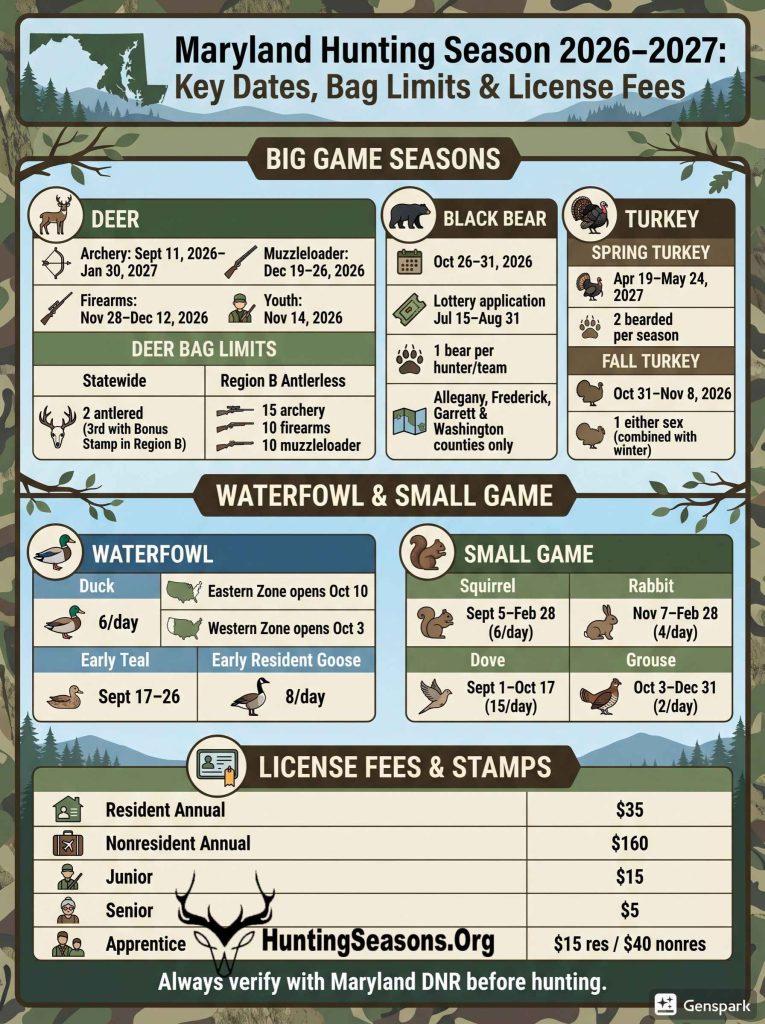
Hunting Licenses and Fees
Maryland’s license fee structure was updated in recent legislation, with increases that took effect to support wildlife management and habitat conservation programs across the state. All licenses can be purchased online through the COMPASS portal or at any licensed sport agent location.
Resident License Fees
| License Type | Fee |
|---|---|
| Annual Hunting License (ages 16–64) | $35.00 |
| Junior Hunting License (under 16) | $15.00 |
| Senior Hunting License (65+) | $5.00 |
| Apprentice Hunting License | $15.00 |
| Trapping License | $35.00 |
| Archery Stamp | $6.00 |
| Muzzleloader Stamp | $6.00 |
| Bonus Antlered Deer Stamp | $10.00 |
| Sika Deer Stamp | $10.00 |
| Migratory Game Bird Stamp | $15.00 |
Nonresident License Fees
| License Type | Fee |
|---|---|
| Annual Hunting License (ages 16–64) | $160.00 |
| Junior Hunting License (under 16) | $80.00 |
| Senior Hunting License (65+) | $65.00 |
| Apprentice Hunting License | $40.00 |
| 3-Day Waterfowl & Small Game License | $65.00 |
| Trapping License | $50.00 |
| Archery Stamp | $25.00 |
| Muzzleloader Stamp | $25.00 |
| Bonus Antlered Deer Stamp | $25.00 |
| Sika Deer Stamp | $200.00 |
| Migratory Game Bird Stamp | $15.00 |
Youth and Senior Licenses
| License Type | Fee |
|---|---|
| Resident Junior License | $15.00 |
| Resident Senior License | $5.00 |
| Nonresident Junior License | $80.00 |
| Nonresident Senior License | $65.00 |
| Resident Apprentice License | $15.00 |
| Nonresident Apprentice License | $40.00 |
Licenses are valid for one year from the date of purchase or until June 30 of the license year, whichever comes first. The apprentice license is a great entry point for new hunters — it requires only a short online hunter safety course and allows you to hunt under the supervision of a licensed mentor. Junior hunters must have written permission from a parent or guardian.
Hunter Education Requirements
| Requirement | Details |
|---|---|
| Minimum Age | No minimum age to hunt with adult supervision; junior license required under 16 |
| Hunter Safety Course | Mandatory for all first-time hunters seeking a regular license |
| Apprentice Option | Available without full course completion; must hunt with licensed mentor |
| Online Course Availability | Full course available online with required field day; apprentice course is fully online |
Maryland’s hunter education program is administered by the Natural Resources Police and covers firearm safety, wildlife identification, hunting ethics, and state-specific regulations. The traditional course includes a classroom component and a field day workshop, but an online-only option is available for those who complete the course material and attend a scheduled field day. The apprentice license streamlines entry into the sport by requiring only a brief online module, but apprentice hunters must be accompanied by a mentor who is at least 18 years old, holds a valid non-apprentice license, and can take immediate control of the hunting device if needed.
Public Hunting Land in Maryland
While Maryland’s total public hunting acreage is modest compared to western states, it’s distributed across the state in a way that puts most hunters within a reasonable drive of quality public ground. The Wildlife & Heritage Service manages 64 WMAs across 19 counties, totaling roughly 128,000 acres, and the state’s forests add tens of thousands more.
Major Public Hunting Areas
| Area Name | Acres | Popular Species |
|---|---|---|
| Savage River State Forest (Garrett Co.) | 55,185 | Deer, bear, turkey, grouse, squirrel |
| Green Ridge State Forest (Allegany Co.) | 49,000 | Deer, turkey, grouse, squirrel |
| Fishing Bay WMA (Dorchester Co.) | 30,387 | Waterfowl, sika deer, deer |
| Potomac-Garrett State Forest (Garrett Co.) | 19,000 | Deer, bear, turkey, grouse |
| Pocomoke State Forest (Worcester Co.) | 18,492 | Deer, turkey, squirrel, waterfowl |
| Deal Island WMA (Somerset Co.) | 13,565 | Waterfowl, snipe, rail |
| Fairmount WMA (Somerset Co.) | 5,240 | Waterfowl, deer |
| Warrior Mountain WMA (Allegany Co.) | 5,305 | Deer, turkey, bear |
Maryland’s public lands fall into several categories. Wildlife Management Areas (WMAs) are the primary hunting destinations, managed specifically for wildlife habitat and hunting access. State Forests like Savage River and Green Ridge offer vast acreage with mountain terrain and excellent big-game and turkey hunting. Natural Resource Management Areas (NRMAs) and Cooperative Wildlife Management Areas (CWMAs) expand access through partnerships with counties and private landowners. The Chesapeake Forest Lands — a massive network of forested parcels across the Eastern Shore and Southern Maryland — provide extensive hunting opportunities for deer, turkey, and small game.
Some public areas require special permits or participate in managed hunt programs with limited access. Always check the specific regulations for each WMA before heading out, as rules regarding vehicles, camping, and weapon types can vary by location.
Special Hunting Programs
| Program | Description |
|---|---|
| Managed Hunts | Lottery-based hunts on select public lands; may require shooter qualification cards and pre-hunt orientation meetings |
| Sunday Hunting Expansion | Permitted in designated counties on private lands and specific public lands; check Sunday hunting chart for details |
| Youth Hunts | Dedicated junior hunt days for deer, turkey, and waterfowl with adult mentor supervision |
| Black Bear Lottery | Limited-entry draw for bear permits in four western counties; application period July 15 – Aug. 31 |
Managed hunt applications are typically submitted through the COMPASS system, and deadlines vary by hunt. Some managed hunts — particularly those in suburban parks or densely populated areas — require hunters to demonstrate shooting proficiency through a qualification card. These programs often allow additional antlerless deer harvest beyond standard bag limits and may include Sunday hunting opportunities not otherwise available.
Important Hunting Regulations
General Hunting Rules
| Regulation | Requirement |
|---|---|
| Hunter Orange | 200 sq inches of daylight fluorescent orange on head, chest, and back during firearms and muzzleloader deer seasons; not required for archery-only or turkey-only hunting |
| Trespassing | Written landowner permission required to hunt on private property; verbal permission is not sufficient |
| Baiting | Prohibited on public lands; permitted on private lands in some counties for deer — check local regulations |
| Drones | Use of drones for hunting, scouting during open season, or recovery of game is prohibited |
| Spotlighting | Use of artificial lights to locate or illuminate wildlife for hunting is illegal |
| Party Hunting | Not permitted; each hunter must harvest and tag their own deer |
| Road Hunting | Illegal to shoot from, across, or along any public road; minimum distance from roadways required |
| Suppressors | Legal for hunting with proper federal registration (NFA tax stamp) |
Maryland takes trespassing seriously — always obtain written permission before hunting private land, and carry that documentation with you in the field. The state’s hunter orange requirement is straightforward: if you’re afield during a firearms or muzzleloader deer season, you need to be visible. Archery hunters are exempt during archery-only dates but must wear orange during overlapping firearm seasons. Electronic calls are prohibited for deer and turkey hunting, though non-electronic mouth and friction calls are perfectly legal. Swimming deer may not be harvested, and hunters must make a reasonable effort to retrieve all wounded game.
Hunting Hours
| Species | Legal Hunting Hours |
|---|---|
| Deer | ½ hour before sunrise to ½ hour after sunset (some Sunday restrictions in certain counties) |
| Turkey (Spring) | ½ hr before sunrise to noon (Apr. 19–May 10); then to sunset (May 11–24) |
| Turkey (Fall/Winter) | ½ hr before sunrise to ½ hr after sunset |
| Waterfowl | ½ hr before sunrise to sunset (federal regulations apply) |
| Small Game | ½ hr before sunrise to ½ hr after sunset |
Sunday hunting hours can differ from weekday hours in some counties, particularly on public lands where shooting may be restricted to morning hours (typically ending at 10:30 AM). Always consult the Sunday hunting chart for the specific county and land type you plan to hunt.
Harvest Reporting Requirements
| Species | Reporting Deadline |
|---|---|
| Deer | By 4:00 PM the day after harvest; same day if it’s the last day of the season |
| Turkey | By 4:00 PM the day after harvest; same day if it’s the last day of the season |
| Bear | Same day at a designated check station |
| Elk | N/A (no elk season in Maryland) |
The reporting process is simple: log into COMPASS or call the toll-free check-in number, enter your license number and harvest details (species, sex, county, and weapon type), and receive a confirmation number. That confirmation number is your permanent proof of legal harvest. Deer and turkey must be tagged in the field immediately after harvest, before being moved from the kill site.
Penalties for Hunting Violations
| Violation | Possible Penalty |
|---|---|
| Hunting Without License | Fines up to $1,500; license revocation; potential jail time |
| Trespassing | Fines up to $500; criminal trespass charges |
| Exceeding Bag Limits | Fines per violation; license revocation; confiscation of game |
| Illegal Harvest (wrong sex/species/zone) | Fines, license revocation, restitution for wildlife value |
| Failure to Report Harvest | Fines up to $200 per unreported animal |
Maryland’s penalties are designed to deter violations and protect wildlife resources. Repeat offenses can result in multi-year license revocations across all hunting and fishing privileges through the Interstate Wildlife Violator Compact. The bottom line is simple: know the rules, follow them, and report your harvests on time.
Maryland Hunting Tips for the 2026-2027 Season
- Hunt the sika deer in Dorchester County — these elusive, marsh-dwelling deer offer a unique experience unlike any other in the Mid-Atlantic, but you’ll need a Sika Deer Stamp and knowledge of the tidal marshes where they thrive.
- Apply for the black bear lottery early — the application window opens July 15 and closes August 31, so mark your calendar; preference points accumulate, so even if you don’t draw this year, you’re building toward future success.
- Study the Sunday hunting chart for your target county — Maryland’s Sunday hunting rules are county-specific and vary by land type (private vs. public), so don’t assume what works in Garrett County applies in Worcester.
- Take advantage of the Suburban Deer Management Zone — if you have access to private land in the developed areas of Region B, archery season offers unlimited antlerless harvest, which is perfect for filling the freezer.
- Carry your written landowner permission — Maryland requires written permission for private land hunting, and conservation officers do check; keep it in your pack at all times.
- Check in your harvest by 4:00 PM the next day — set a phone alarm if you need to, because missing the reporting deadline is one of the most common — and easily avoidable — violations in the state.
- Use the COMPASS portal for all license purchases — it’s faster than visiting an agent, and you can store all your stamps and permits digitally; you’ll also find harvest reporting built right into the system.
- Scout the Chesapeake Forest Lands on the Eastern Shore — these interconnected parcels offer excellent deer and turkey hunting with less pressure than the more well-known WMAs.
- Wear hunter orange during muzzleloader season — many hunters forget that the orange requirement applies to muzzleloader dates too, not just the regular firearms season.
- Pack bug spray for September archery — Maryland’s early archery season coincides with peak mosquito and tick activity, especially in the coastal and marsh areas; permethrin-treated clothing is a smart investment.
- Register for HIP before hunting doves — the Harvest Information Program is free but mandatory for all migratory bird hunters, and you must have your confirmation number with you in the field.
- Bring waders for Fishing Bay WMA — much of this 30,000+ acre area is tidal marsh, and chest waders or a boat are essential for accessing the best sika deer and waterfowl spots.
- Know the antler point restriction before you shoot — you’re allowed one buck that doesn’t meet the 3-point minimum, but every buck after that needs at least three points on one antler; count carefully before pulling the trigger.
- Consider the apprentice license to introduce a friend — it’s only $15 for residents and requires just a short online course, making it the easiest way to get someone new into the sport without a major upfront commitment.
- Verify sea duck zone boundaries before hunting offshore — the sea duck zone has specific distance requirements (typically 800 yards from shore), and the boundaries are mapped through the DNR’s interactive ArcGIS viewer.
Frequently Asked Questions
How much does a Maryland hunting license cost?
A resident annual hunting license costs $35 for hunters ages 16–64. Seniors 65 and older pay just $5, and juniors under 16 pay $15. Nonresident hunters pay $160 for an annual license, $65 for seniors, and $80 for juniors. Additional stamps are required for archery ($6 resident / $25 nonresident), muzzleloader ($6 / $25), sika deer ($10 / $200), and migratory birds ($15 for all).
When does deer hunting season start in Maryland?
Archery deer season opens in early September (typically around September 11) and runs through the end of January. Firearms season generally opens in late November, and muzzleloader seasons occur in late October and late December. Youth hunters get their own dedicated weekend in mid-November.
Can I hunt on Sundays in Maryland?
Sunday hunting is permitted in many Maryland counties, but the rules vary significantly. Some counties allow Sunday hunting on private lands only, while others include designated public lands. Shooting hours on Sundays may also be restricted (often ending at 10:30 AM on public lands). Always check the current Sunday hunting chart for your specific county and location.
Is there a sika deer season in Maryland?
Yes — Maryland is one of the few states where sika deer can be hunted. They’re found primarily in Dorchester County on the Eastern Shore, particularly in the tidal marshes. A Sika Deer Stamp ($10 for residents, $200 for nonresidents) is required in addition to your regular hunting license and the appropriate weapon stamp.
Do I need hunter education to hunt in Maryland?
Yes, all first-time hunters must complete a hunter safety course before obtaining a regular hunting license. However, you can purchase an Apprentice Hunting License ($15 for residents) which requires only a short online course and allows you to hunt under the direct supervision of a licensed mentor. The full course is available online with an in-person field day component.
Where are the best public hunting areas in Maryland?
For big game, Savage River State Forest (55,185 acres) and Green Ridge State Forest (49,000 acres) in western Maryland are top destinations. On the Eastern Shore, Fishing Bay WMA (30,387 acres) is excellent for waterfowl and sika deer. Pocomoke State Forest (18,492 acres) in Worcester County offers great deer and turkey hunting.
Can I use a rifle to hunt deer in Maryland?
Rifle use for deer hunting is restricted in Maryland. Straight-walled cartridge rifles are legal in certain counties during firearms season, but traditional bottleneck-caliber rifles are limited to specific areas. Shotguns with slugs are the most widely legal firearm statewide, except in Dorchester County where buckshot is permitted. Always verify county-specific weapon restrictions before your hunt.
How do I apply for the black bear lottery in Maryland?
Applications for the Maryland Black Bear Lottery are accepted from July 15 through August 31 each year through the COMPASS portal or at any sport license agent. The $15 application fee is nonrefundable, and you can only enter once per year. The drawing is held in early September, and preference points accumulate for those who aren’t selected.
What is the bag limit for deer in Maryland?
The statewide antlered deer bag limit is 2 per license year (no more than 1 per weapon season). A third antlered deer can be taken in Region B with a Bonus Antlered Deer Stamp. Antlerless limits vary by region: Region A allows 2 total, while Region B allows 15 during archery, 10 during muzzleloader, and 10 during firearms seasons.
Do I need a federal duck stamp to hunt waterfowl in Maryland?
Yes — all waterfowl hunters age 16 and older must carry a valid Federal Migratory Bird Hunting and Conservation Stamp (commonly called a duck stamp), which costs $29. You’ll also need the Maryland Migratory Game Bird Stamp ($15) and HIP registration. All three are required simultaneously.
Is baiting legal for deer hunting in Maryland?
Baiting is prohibited on all public hunting lands in Maryland. On private lands, baiting regulations vary by county — it’s legal in some areas and prohibited in others. Always confirm the rules for the specific county where you’ll be hunting before placing any bait.
What are the legal hunting hours in Maryland?
General hunting hours run from a half hour before sunrise to a half hour after sunset for most species. The exception is the early part of spring turkey season (April 19 – May 10), when hours end at noon. Waterfowl hunting follows federal regulations, ending at sunset. Sunday hours may be shortened in certain counties, particularly on public lands.
Can I hunt coyotes year-round in Maryland?
Yes — coyote hunting is open year-round in Maryland with no bag limit. You can use firearms, archery equipment, or air guns. Trapping seasons are more restricted, running from October 31 to February 15 east of the Chesapeake Bay and November 14 to February 28 west of the bay.
Final Thoughts
Maryland’s 2026-2027 hunting season offers a rich tapestry of opportunities that few states of its size can match. From the mountain hollows of Garrett County where black bears roam, to the tidal marshes of Dorchester County where sika deer slip through the reeds, the state provides an impressive range of experiences for hunters of every stripe. White-tailed deer remain the most sought-after game, with generous bag limits in Region B and multiple season options that stretch across five months of the calendar.
Following MDNR regulations isn’t just about avoiding fines — it’s about being a responsible steward of Maryland’s wildlife resources. The DNR sets bag limits, season lengths, and zone boundaries based on rigorous population data and biological assessments. When you follow those rules, you’re contributing to the long-term health of the state’s game populations and ensuring that future generations of hunters will enjoy the same opportunities you have today.
Licensing requirements are straightforward but shouldn’t be overlooked. Make sure you have the right license, the appropriate stamps for your chosen weapon and species, and any special permits like the sika deer stamp or black bear lottery application. The COMPASS system makes purchasing and managing your credentials simple, and harvest reporting is built right into the platform. Budget for the fees in advance — between your base license, stamps, and permits, costs can add up quickly, especially for nonresidents.
Public land access in Maryland is better than many hunters realize. With 64 WMAs, multiple state forests, and the extensive Chesapeake Forest Lands network, there’s quality hunting ground in nearly every region of the state. Take time to scout these areas, understand their specific regulations, and consider applying for managed hunts that offer less crowded, higher-quality experiences. The more you know about your chosen public area, the better your chances of success.
Safety should always be your top priority. Wear your hunter orange when required, maintain positive identification of your target and what’s beyond it, and always let someone know where you’ll be hunting and when you expect to return. Tree stand safety is particularly important — wear a full-body harness and use a lifeline from the moment you leave the ground. These simple habits have saved countless lives, and they cost nothing but a few moments of your time.
Perhaps the most important thing every hunter should keep in mind is that regulations change annually. Season dates shift, bag limits get adjusted based on population data, new Sunday hunting counties are added, and permit fees can change. That’s why it’s absolutely critical to review the current year’s regulations before heading afield. You can always cross-reference the details in this guide with Maryland’s official hunting and trapping information to make sure you’re working with the most up-to-date rules.

- 2026-2027 Nevada Hunting Seasons New Dates & Regulations - August 13, 2026
- NC Turkey Season 2026 New Dates & Rules - July 23, 2026
- Thrilling 2026-2027 NM Elk, Deer And Pronghorn Season! - July 23, 2026